 ananoid
Utilities: Complexity Calculator
While ananoid's defaults are a good choice for many use cases, it can nevertheless be desirable to change the size or alaphabet used for generating Nano IDs. To that end, the libray ships with a number pre-defined alphabets, and even lets you define your own. However, it's important to understand the relationship between alphabet, nano id length, and the possibility (however small) of having collisions. To help with this, the ananoid repository contains a small tool, called anaoidcc (inspired by the excellent nano-id-cc!), which can help you figure out the likelihood of collisions for a given alphabet and nano id length.
Attention!!!
So far, ananoidcc has only been tested on Ubuntu 24.04 and Windows 11.
Features
ananoidcc
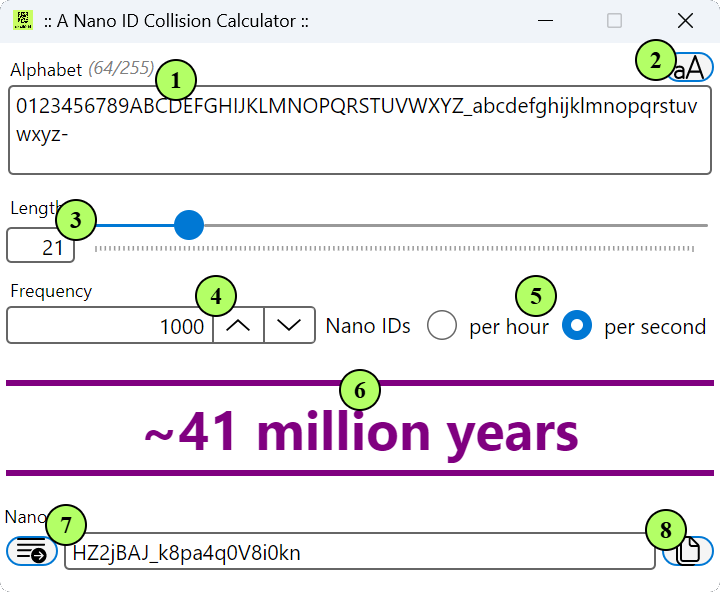
- Alphabet ... the set of "letters" from which a Nano ID is generated. Can be one of the pre-defined sets, or a custom one.
- Alphabet Picker ... a dropdown to select one of the pre-defined alphabets, which will automatically update the 'Alphabet' field.
- Desired Length ... the length of the Nano ID to be generated. The longer the length, the less likely it is to have collisions.
- Frequency ... the number of Nano IDs generated per interval. This is relevant for calculating the likelihood of collisions, as the more nano ids are generated, the higher the chances of a collision.
- Frequency Interval ... the time interval for which the frequency is calculated, either per hour or per second.
- Complexity ... the likelihood (at a probability of 1%) of a collision, expressed as a duration of time. The longer the duration, the less likely it is to have a collision.
- Generator ... the command to generate a Nano ID with the specified alphabet and length.
- Clipboard ... a button to copy the generated Nano ID to the clipboard, for easy pasting into other applications.
Installation
The ananoidcc tool can be built from source following the instructions in the README file for the repository. However, pre-compiled binaries are also available for download, for both Windows and Linux. Once downloaded:
- Unzip the downloaded file to a location of your choice.
- Double-click the
ananoidccexecutable to launch the tool.
Calculation
Similar to UUID, there is always a possibility of a collision when generating Nano IDs. It remains very low, but it is non-zero. More importantly, the likelihood of a collision depends on several factors:
- The size of the alphabet (ie: the number of possible characters that can be used to generate a Nano ID);
- The number of letters in the of the generated Nano ID;
- The frequency of generation (ie: how many Nano IDs are generated per unit of time).
The ananoidcc tool calculates the likelihood of a collision, while letting you adjust the various parameters.
Using the birthday problem and birthday attack mathematics, the tool effectively estimates the number of Nano
IDs that can be generated before a collision occurs, with a probability (p) of 1%. The estimation is based on the
formula: n(p;H) ≈ √(2H·ln(1/(1-p))), where H = 2^entropy and entropy is the possible number of bits in a single
generated identifier. It then calculates the time it would take to generate that many Nano IDs at the specified
frequency (ie: at a stable rate of generation).
The code can be (roughly) explained as follows:
Further Reading
Copyright
The library is available under the Mozilla Public License, Version 2.0. For more information see the project's License file.
val float: value: 'T -> float (requires member op_Explicit)
--------------------
type float = System.Double
--------------------
type float<'Measure> = float